If you spend a summer Saturday in rural Iceland and hear what sounds like a small earthquake echoing off a mountainside, you are probably within a few kilometres of a torfæra event. Formula Offroad — known to locals simply as torfæra — is a home-grown Icelandic motorsport in which purpose-built buggies running on methanol claw their way up cliffs, ravines, and river beds that no normal vehicle could ever attempt. It is loud, dramatic, and genuinely unlike any other motorsport in the world.
Most visitors to Iceland never hear about it. That is a shame, because for the price of a coffee in Reykjavík you can spend an afternoon watching 1,000-horsepower machines try to climb a near-vertical wall of volcanic rock. If your trip falls between May and September and you are anywhere in the Icelandic countryside on a weekend, it is worth checking the calendar.
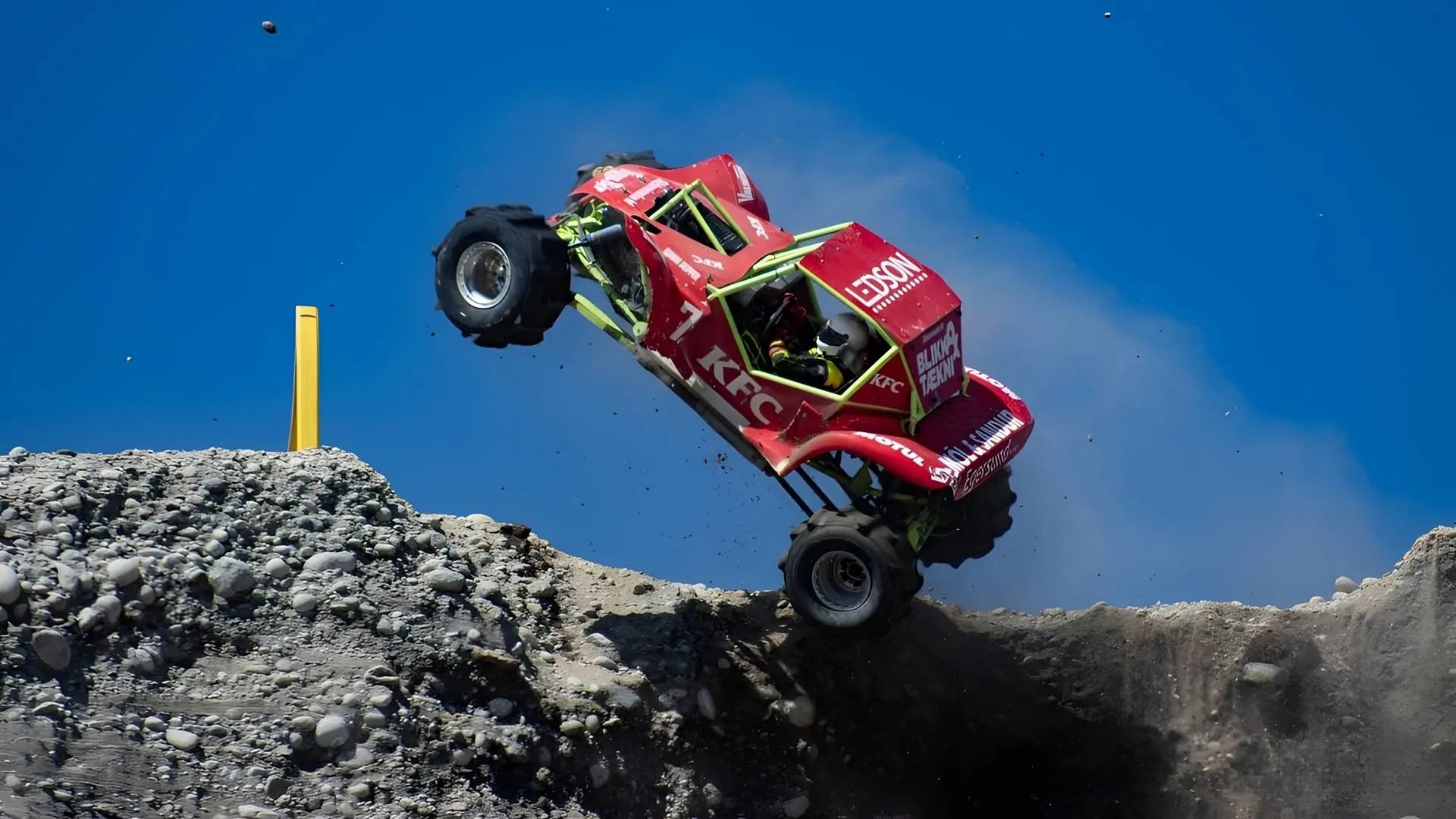
If you see a championship round near your route, go for two or three hours. You do not need to understand motorsport first; just bring layers, ear protection for kids, and follow the marshals' lines.
See It in Action First
Words don't really do torfæra justice. Watch one minute of this and the rest of the article will make sense:
Drivers tackle a series of obstacles ("þrautir") set into natural terrain — riverbanks, gravel slopes, lava walls. Each obstacle has gates worth different points. Reach the top gate without rolling, getting stuck, or crossing a boundary line, and you score the maximum. Fail at gate three, and you score whatever points the gates below it were worth. Highest cumulative score over the day wins.
Where Torfæra Came From
The first formal torfæra competition in Iceland was held on 2 May 1965 in Reykjahlíð in Mosfellssveit, hosted by Bifreiðaklúbbur Reykjavíkur (BKR), the Reykjavík motoring club. The first winner was Egill Gunnar Ingólfsson. From there the sport grew quickly through the 1970s and 80s among Icelandic farmers and mechanics who had spent years modifying jeeps and Soviet-era trucks to cope with the country's roadless interior.
What began as modified Willys jeeps and Russian GAZ trucks evolved over the following decades into a class of purpose-built tube-chassis buggies that bear no resemblance to any production car. The sport was rebranded internationally as "Formula Offroad" in the 1990s when it began to spread to Norway, Sweden, Finland, and eventually the United States — but in Iceland, where the sport was born, almost nobody calls it that. It is torfæra, full stop.
The Cars
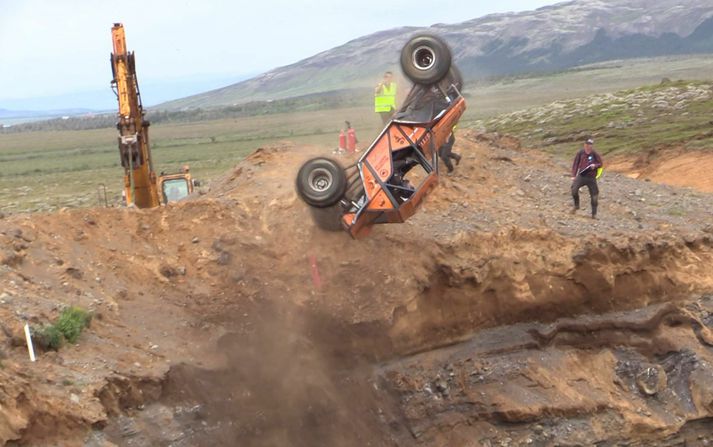
A modern top-class torfæra car is one of the most extreme machines in any motorsport. The chassis is a hand-built tubular space frame, the engine is usually a heavily modified American V8 running on methanol, and the tyres are paddle-cut for traction on loose volcanic gravel. Power-to-weight ratios are ridiculous — well over a thousand horsepower in a car that weighs roughly the same as a small hatchback. The cars do not really drive across the obstacles; they explode up them.
Off-road driving is illegal in Iceland and damages fragile ground. Torfæra happens on controlled competition courses. Visitors should never try to copy it with a rental car.
| Class | What it is |
|---|---|
| Street Legal / Standard | Modified production 4×4s — Land Cruisers, Patrols, occasionally Suzukis. Road-registered. The entry level of the sport. |
| Modified | Heavily modified production-based vehicles with non-standard engines, suspension, and roll cages. Not road legal. |
| Unlimited | Purpose-built tube-chassis buggies. Methanol-fuelled V8s, paddle tyres, four-wheel steering. The headline class. |
Methanol burns cooler than gasoline and tolerates extreme compression, which suits the punishing short-burst nature of torfæra obstacles. It also produces an unmistakable sweet, slightly chemical smell at the start line — once you have smelled a torfæra paddock, you will recognise it anywhere.
How a Day Goes
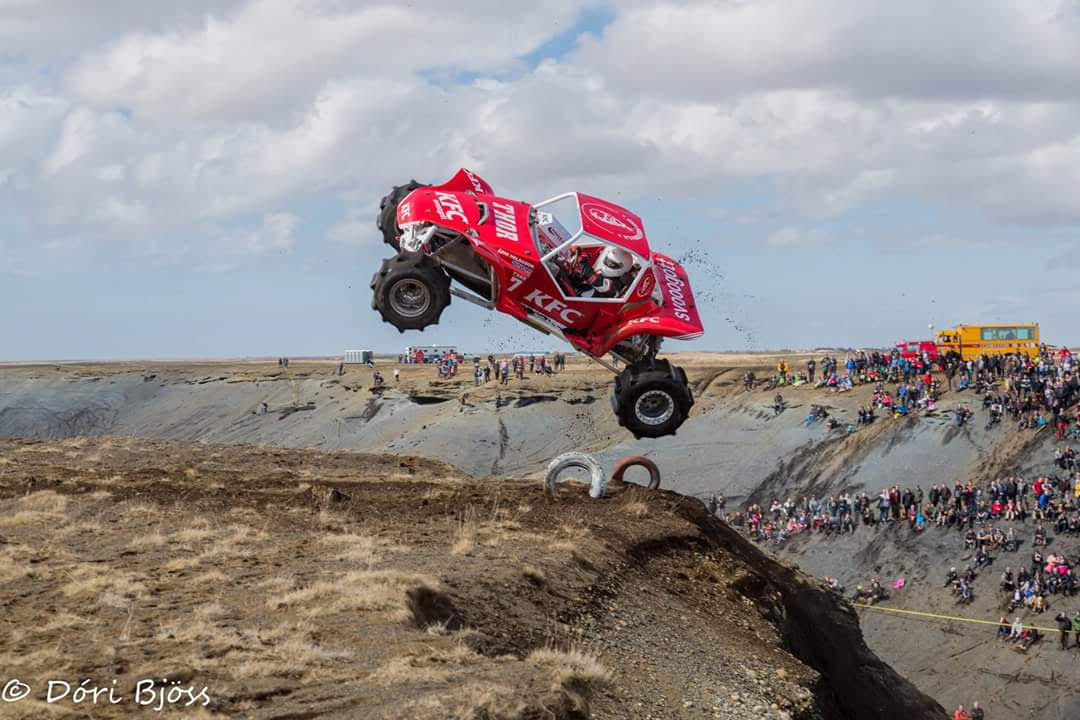
A torfæra event is structured around a series of obstacles set into a chosen patch of terrain — the choice of terrain is half the art of the sport. Each obstacle is a numbered route up a slope, through a ravine, or across a riverbed, marked out with gates that the driver has to pass through in order. Higher gates are worth more points. The obstacles are designed to be near the limit of what the cars can do, which means most attempts end in a spectacular failure rather than a clean finish.
Before each run drivers walk the obstacle on foot to plan a line — which lava block to brace against, where the wheels need to be at the crux move, where the recovery rope can reach if it all goes wrong. The course designers will have set the gates to reward bravery and precision; a safe line scores few points.
Drivers take a run-up — sometimes only ten metres of flat gravel — and hit the obstacle at full throttle. A successful attempt is over in under fifteen seconds. The car claws upward in a spray of stones, the engine note climbs into pure noise, and either it crests the top gate or it doesn't.
Failed attempts are part of the show. Cars roll, beach themselves on rocks, or simply run out of grip halfway up. Recovery crews with winch trucks and tractors haul them out, sometimes upside-down, almost always still running. Drivers climb out, shrug, and queue up for the next obstacle.
Drivers to Watch
Torfæra has its own pantheon of names that any Icelandic crowd will recognise the moment a car rolls up to the start line. A few worth knowing:
- Guðbjörn Grímsson — one of the most familiar Unlimited-class drivers, famous for a 1,600-horsepower car that has crossed running rivers and cleared obstacles most drivers will not even attempt.
- Gestur J. Ingólfsson — drives the iconic Draumurinn ("The Dream"), a longtime fixture on the championship calendar.
- Ingólfur Guðvarðarson — Akureyri-based driver, regularly competing on the international NEZ (Northern European Zone) circuit as well.
- Ólafur Jónsson — multi-year Unlimited champion until the title changed hands in the early 2010s.
Where to Watch
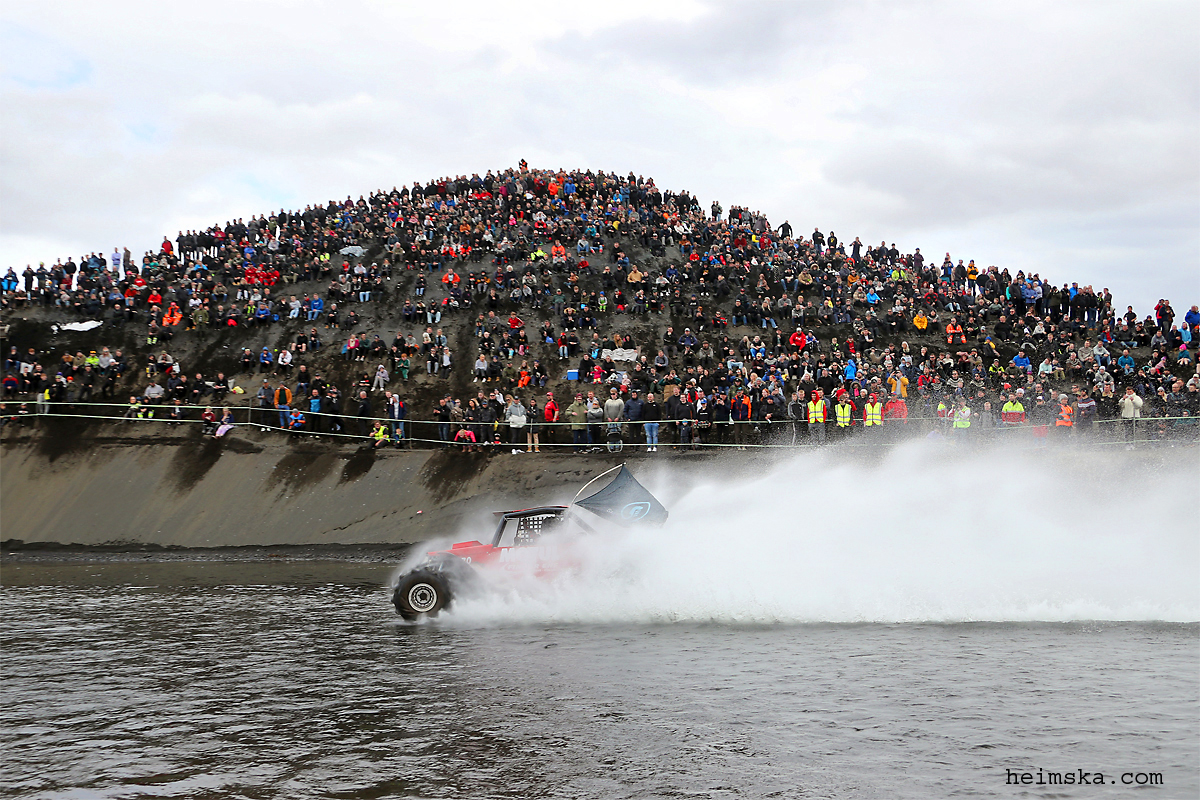
The Icelandic championship runs from late spring to early autumn at venues scattered around the country. Each round is hosted by a local motorsport club and the venue varies year to year, but the same handful of regions consistently appear on the calendar. Events typically run Friday evening through Saturday afternoon and cost a few thousand krónur to attend.
When to Go
The Icelandic championship typically runs five to six rounds between May and September. Exact dates and venues are published each spring by AKÍS (akis.is), the national motorsport federation. The mid-summer rounds in June and July are the most popular — the long Icelandic daylight means events can run late into the evening and the weather is at its most cooperative. Early-season rounds in May can be cold and wet, but the obstacles are at their most challenging because the ground is still saturated and grippy.
The official calendar is published at akis.is. Local clubs also post detailed event information on Facebook — searching for "torfæra" on Facebook is genuinely the most reliable way to find which event is happening on a given weekend. Most events list start times for each class and rough timings for the obstacles.
Practical Information for Spectators
Torfæra is a refreshingly informal motorsport. There are no grandstands, no reserved seating, and no hospitality boxes. You buy a ticket at the gate, walk in, and stand wherever the marshals will let you. Bring sensible clothing — even in July a torfæra venue can be cold and windy, and obstacles are often in exposed bowls of black gravel that the wind howls through.
Stand higher than the obstacle if marshals allow it, not directly below the cars. The view is better, the sound is still huge, and you avoid the gravel spray.
What to bring
- Warm layers — a wool jumper and a windproof jacket, even in July
- Waterproof shoes or boots (the venues are gravel, mud, and occasionally river crossings)
- Ear protection — the cars are genuinely loud, and small children should wear ear defenders
- Sunglasses (the gravel kicks up; you will want them whether the sun is out or not)
- Cash for the entrance fee and the food truck — card readers are not always reliable in remote venues
- A camera with a fast shutter — the action is short, sudden, and dramatic
The marshals will rope off zones around each obstacle for a reason. Cars sometimes lose traction near the top gate and slide back down at speed, and rocks dislodged by the paddle tyres can fly a long way. Watch from the marked spectator areas only. If a marshal moves you, move — they have seen things go wrong before.
Getting there
Most torfæra venues are not served by public transport. You will need a car. A standard rental car is fine — the venues themselves are reached by gravel access roads but never require a 4×4 or any of the F-road permissions. If you are unsure about whether your rental is allowed on a particular gravel road, check with the rental company first; some Icelandic rental contracts are unexpectedly strict about gravel surfaces. Our guide to renting a car in Iceland goes into the insurance details.
Food and facilities
Expect a single food truck or a tent run by the local club selling pylsur (the famous Icelandic hot dog), waffles, and coffee. There will be a couple of portable toilets. There will not be much else. This is part of the charm — torfæra is a community sport, run by volunteers, in places where the nearest shop might be twenty minutes' drive.
Why Icelanders Love It
Torfæra is one of those sports that makes more sense when you understand the country it came from. Iceland's interior has always demanded vehicles that could cope with rivers, lava, and deep snow — the modified jeep is part of the national identity, especially in the north and east. Torfæra started as the natural extension of that culture: take the kind of vehicle every farmer was already building in his shed, and find out whose build copes best with the toughest obstacle.
That community spirit is still visible at any modern event. The drivers are mostly amateurs who pay for their own cars and travel with their families. The crews are volunteers. The atmosphere in the paddock is closer to a rural agricultural show than a Formula 1 race — drivers will happily walk you around their car, explain the engine, and let your kids sit in the seat. There is no other motorsport on earth where you can do that.
The Sport Abroad
Formula Offroad spread from Iceland to Norway in the 1980s and from there into the rest of Scandinavia. There is now a Nordic championship (the NEZ — Northern European Zone) and an active scene in the United States, primarily in Utah and Colorado. The international rule book is broadly the Icelandic one, with minor adjustments for venue size and local insurance requirements. Top Icelandic drivers regularly travel to compete abroad — and visiting drivers come to Iceland for the harder, more traditional courses.
Glossary — Torfæra in Five Words
- Torfæra — the Icelandic name for the sport; literally "obstacle" or "rough terrain". Locals never call it Formula Offroad.
- Þraut (pl. þrautir) — an obstacle. A single torfæra event will have eight to twelve þrautir set into the terrain.
- Hlið — a gate. Each þraut is marked with numbered gates worth increasing points. Reaching gate ten without breaching the rules scores the maximum.
- Ókláruð — "did not finish". The official term for an obstacle attempt that ends in a roll, beach, or boundary breach.
- Spaði-dekk — paddle tyres. The cup-shaped rubber tread that throws gravel and gives the cars grip on loose volcanic surfaces.
The Bottom Line
If your Iceland trip happens to overlap with a torfæra event, go. It costs almost nothing, it takes a couple of hours, and it shows you a side of Icelandic culture that is impossible to find on a guided tour. You will see machines doing things that should not physically be possible, run by people who will happily explain how they built them. It is the loudest, friendliest motorsport in the world — and it only really exists here.