Every first-time visitor to Iceland is told the same thing: "Try the hot dog." It appears on every list, in every guidebook, and on every walking tour — almost always pointing you toward a single famous stand by Reykjavík harbour. What nobody bothers to tell you is that the Icelandic hot dog is not just a snack. It is a quiet national obsession, a low-level religious argument about which stand is best, and a small leftover from the days when Iceland was under Denmark. Icelanders have been eating them since childhood and have strong opinions about them. The stand tourists queue up at is not where most of us actually go.
This is a guide to the pylsa written by someone who has been eating them (and at one point, preparing them behind the counter of a petrol station) his whole life. It covers the mainstream stops you still might want to tick off, and the ones locals actually swear by — plus a few things you will not read anywhere else.
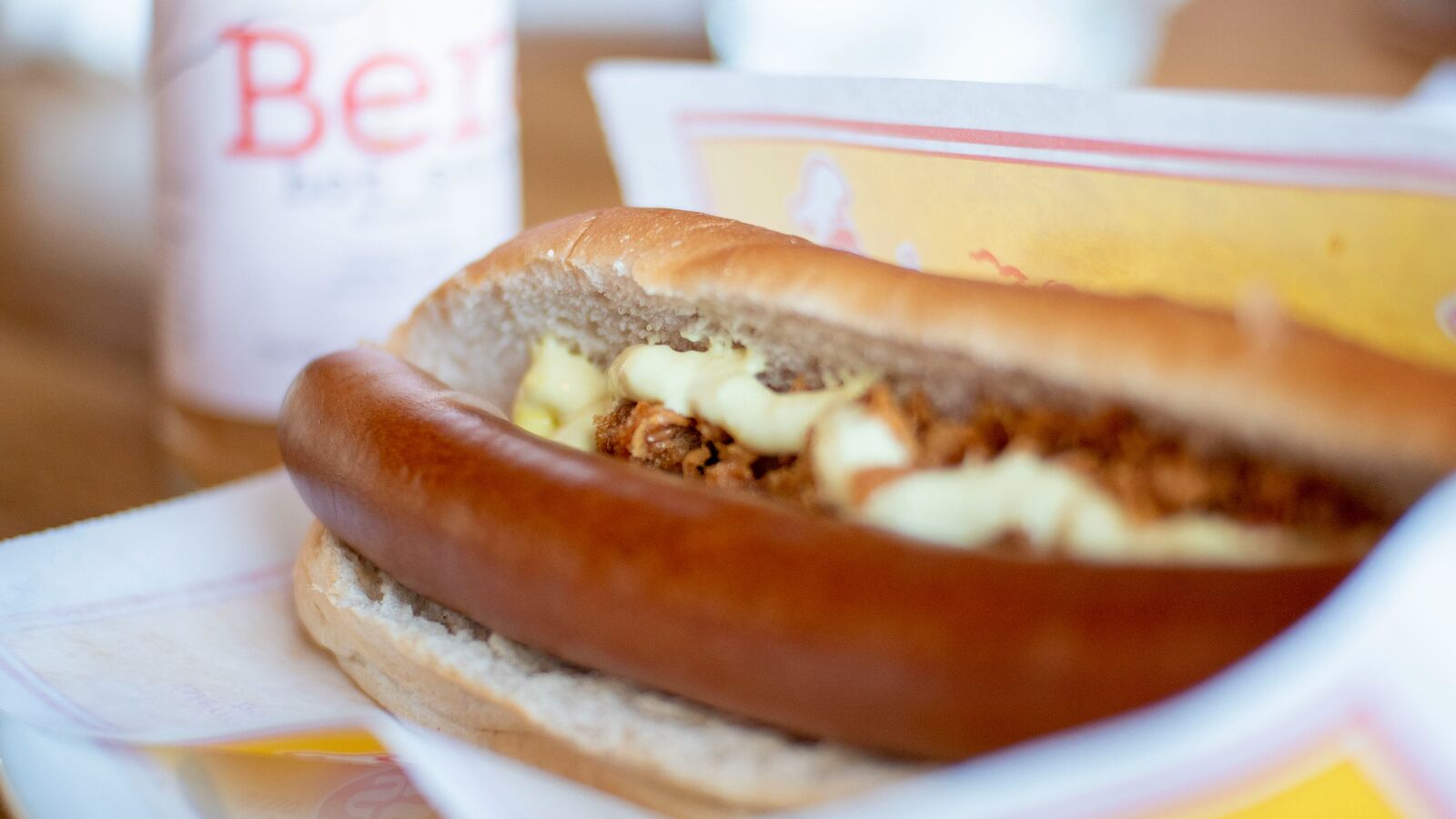
You will see both spellings on menus, signs, and shop fronts. Pylsa is the formal Icelandic word. Pulsa is the colloquial version — closer in pronunciation to the Danish pølse, which is almost certainly where it originally came from. Iceland was under Denmark for centuries, and a huge share of everyday Icelandic food vocabulary (kaka, kartafla, pönnukaka, and pylsa itself) travelled north from Copenhagen.
Some Icelanders insist pylsa is the only correct spelling and treat pulsa as sloppy. Others use pulsa without thinking twice. Bæjarins Beztu brands itself formally as Bæjarins Beztu Pylsur. You can use either and no one will actually stop you — but now you know why there are two.
What Makes an Icelandic Hot Dog Different
If you picture a hot dog as a pink pork sausage in a supermarket bun with a squeeze of yellow mustard — forget all of it. The Icelandic pylsa is its own thing.
The sausage itself is a mix of lamb, pork, and beef, with lamb doing most of the flavour work. Icelandic lamb is almost entirely free-range, grazing on wild herbs and mountain grass all summer, and you can taste it even through everything else stacked on top. The casing has a satisfying snap when you bite into it.
What really defines the pylsa, though, is the combination of toppings. There are exactly five, and the order they go on matters:
- Hrár laukur — finely chopped raw white onion at the bottom of the bun
- Pylsusinnep — a sweet, smooth Icelandic brown mustard. Not the sharp yellow American version.
- Tómatsósa — ketchup, but slightly less sweet than Heinz
- Remúlaði — a pale, tangy mayo-based sauce with finely chopped pickle, capers, and a little mustard. The signature Nordic condiment.
- Steiktur laukur — crispy fried onion scattered on top for crunch
All five together. None of them are optional — and that is not just tradition, it is the whole point. The pylsa is an experience of several textures and flavours hitting at once: crunch, tang, sweetness, richness, the soft steamed bun. Skip anything and you are eating something else.
How to Order: "Eina Með Öllu"
If you only learn one Icelandic phrase for your whole trip, make it this one.
Ordering it any other way — with just ketchup, or without the raw onion, or "can I have it without the remoulade sauce, please?" — marks you out instantly as a tourist. It is also, to be honest, a waste. The whole thing is built on the five toppings working together. Leaving one out is like ordering sushi without the rice.
Where to Get One in Reykjavík
Reykjavík has more than one good hot dog stand. The tourists all go to the same one. Here is where locals go.
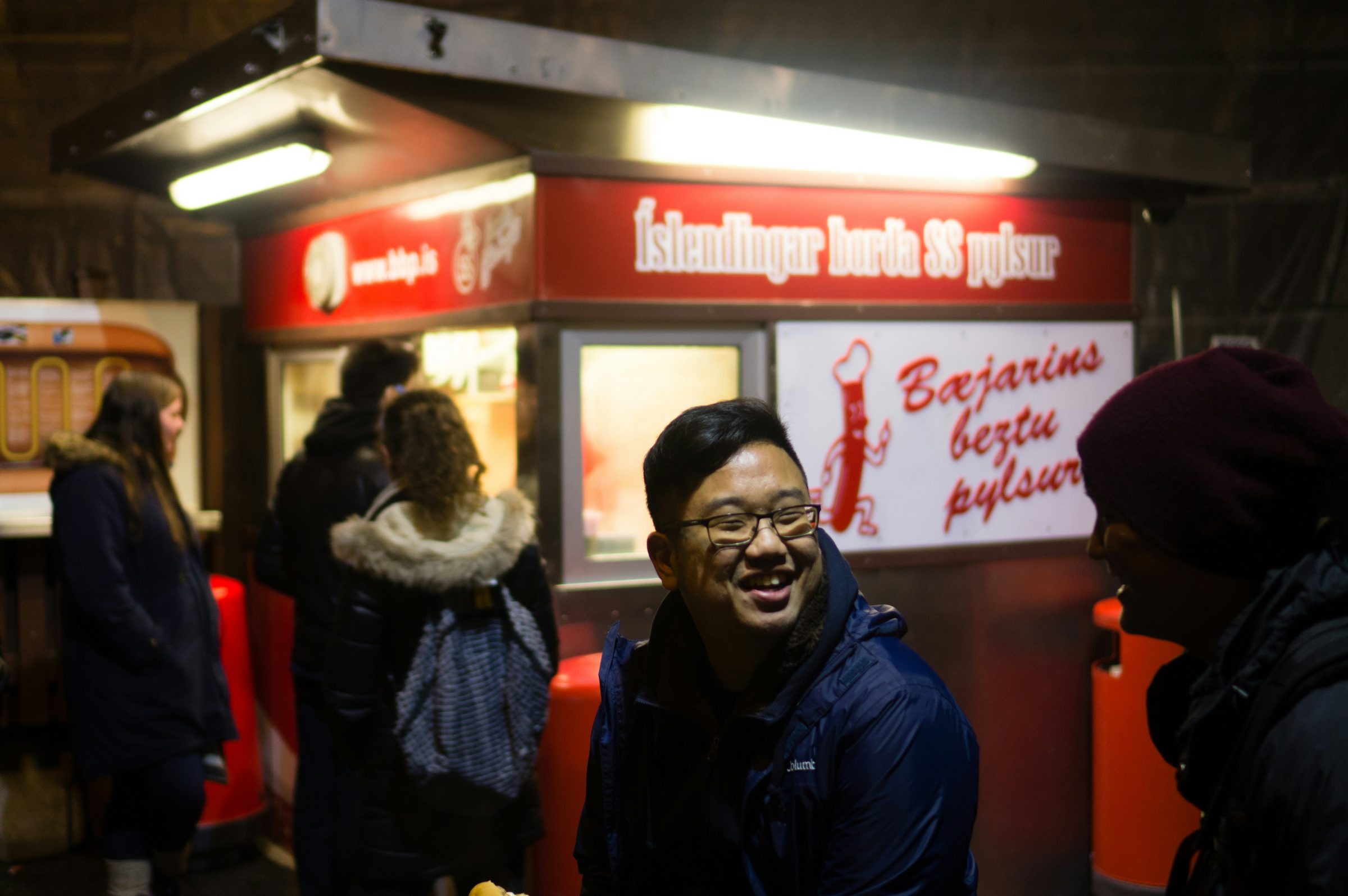
There are plenty of other spots in and around Reykjavík — most petrol stations serve a decent hot dog, and several late-night takeaway places do a fine version. But for a deliberate pylsa pilgrimage, those two cover the span: the one you will tell people you went to, and the one you will actually remember eating.
If you would like to try several iconic Icelandic foods (including a proper pylsa) on a single guided outing, Reykjavík has a few small-group food walks led by locals that cover bakeries, fish soup, lamb, and the hot dog in one loop. See food walks in Reykjavík →
Beyond Reykjavík: Regional Variants Worth Hunting
Leave the capital and the hot dog changes shape. A few stops are well worth planning around if you are driving the Ring Road or spending time in the north.
A lot of travel blogs and AI answers will tell you the djúpsteikt pylsa is sold at N1 and Orkan — the big yellow and red petrol station chains. It is not. Those places sell regular pylsur and decent pan-grilled variants, but the deep-fried version is a specialty of small independent shops, hot dog vans, and local cafés. Do not pull off the Ring Road at a petrol station expecting one and come away disappointed.
If You Want to Try It at Home: SS vs the Rest
You can buy Icelandic pylsur in every supermarket — they come in plastic packs of ten, usually in the refrigerated meat aisle. If you are road-tripping and want to save money, a pack of pylsur and some buns from Bónus or Krónan is one of the cheapest proper meals you can put together in Iceland.
There is a brand debate worth knowing about. The three you will see are SS, Ali, and various Bónus/Krónan own-brand offerings. Most Icelanders — myself included — will tell you SS is the original and still the best: a cleaner, leaner, more lamb-forward flavour. Ali is the usual alternative and perfectly acceptable. The supermarket own brands are cheaper and fine in a pinch, but if you can find SS, get SS. It is not snobbery, it is just a genuine quality difference.
The Cooking Liquid Secret Nobody Mentions
Here is something you will not read on any travel blog, because no one outside the Icelandic petrol station world tends to know it. I used to work at a gas station. I used to cook the hot dogs. And the pylsa is not just dropped into plain boiling water.
At most Icelandic petrol stations, the pylsur are simmered in a bath of water, beef bouillon (kjötkraftur), and non-alcoholic pilsner. The bouillon adds savoury depth. The pilsner adds a very subtle malty backnote. Together they are why the pylsa at a petrol station tastes distinctly better than one you boil at home in plain tap water — even if the sausage itself is the same SS pylsa you can buy in any supermarket.
If you are trying to recreate the pylsa at home after your trip, this is the trick. A beef stock cube and a splash of non-alcoholic pilsner in the pan will get you noticeably closer to the real thing than plain water ever will.
The "Americanised" Versions to Skip
A few variants have crept into Icelandic petrol stations over the years that are not really in the spirit of the classic pylsa. They are not bad — some people like them fine — but if you want the authentic experience, these are not it.
Pan-grilled pylsur are sometimes offered at petrol stations as an upgrade, laid on a hotplate and seared dark. They taste more like a generic grilled sausage than a proper Icelandic hot dog, and they lose the snap of the simmered version.
Bacon-wrapped pylsur have showed up on some menus in the last several years. They are borrowed from American hot dog culture, and while there is nothing wrong with bacon, wrapping it around a pylsa hides exactly the thing that makes the Icelandic hot dog itself — the lamb, the casing, the balance with the toppings. If the menu lists one, it is usually a sign the place is catering more to tourists than to locals.
The classic simmered pylsa, in a steamed bun, with all five toppings, is the one to chase.
The Bottom Line
The pylsa is the best cheap meal in Iceland, full stop. For the equivalent of a cup of coffee you get a meal that is genuinely delicious, deeply local, and comes with a small education in Icelandic food history whether you wanted one or not. Order it right ("eina með öllu"), do not skip any of the toppings, and try at least one proper local spot on top of the famous ones. If you only visit Bæjarins Beztu you will leave saying "it was fine." If you also stop at Borgarpylsur in Skeifan, or a djúpsteikt somewhere in the north, or the pylsuvagn in Selfoss, you will leave understanding why Icelanders actually care about this little sausage.